Hyperscalers driving record clean energy deals: CEBA CEO
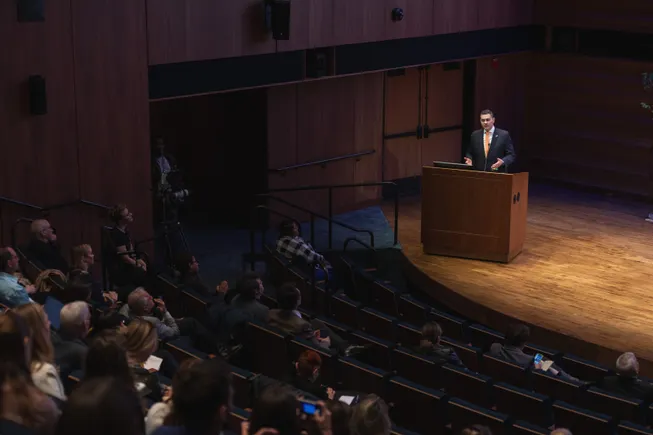
WASHINGTON — Despite recent rollbacks in federal tax incentives for clean energy, U.S. corporate energy procurements reached a record last year of more than 27 gigawatts, according to the Corporate Energy Buyers Association.
CEBA CEO Rich Powell was in Washington D.C. last month for the city’s second climate week, and told attendees during an April 20 talk that “the pace of new [clean energy] buying is accelerating.” CEBA has tallied over 130 GW of procured energy since 2014.
CEBA, which changed its name from the Clean Energy Buyers Association in March, is a nonprofit and trade association that consists of large corporate buyers of clean electricity in the U.S. and represents over 300 members with more than $38 trillion in market capitalization. The group aims to fast-track the clean energy transition by advocating for and helping procure electricity systems that are reliable, low in cost and free of carbon emissions.
Powell told attendees at DC Climate Week that 17 GW of clean energy was procured in Q1 of 2026 — according to an estimate from S&P Global — which puts the market on pace for “by far, the largest year ever in corporate clean energy buying.”
While members have increased the pace of purchasing, reforms to permitting and transmission remain a priority and barrier to corporate clean energy procurement, Powell explained in an interview with ESG Dive last month.
“Corporate clean energy demand remains extremely strong,” Powell said. “To keep it strong, we need fundamental permitting and transmission reform, at the very least in D.C.”
ESG Dive sat down with Powell at the conference to unpack the pace of clean energy procurement, and whether recent changes in federal policy have impacted demand.
Editor’s note: This interview has been edited for length and clarity.
ESG DIVE: What trends have you been watching over the last year?
RICH POWELL: The trend is just ever greater corporate clean energy buying right in the U.S. and around the world. In the U.S., [CEBA announced] that we hit 27 GW of new contracted clean energy in 2025, so the biggest year ever. And that was across all types of carbon emissions-free energy — so wind, solar, nuclear, geothermal, gas with [carbon capture and storage], even fusion deals.
We’re seeing a rising share of that clean, firm energy as part of the mix of the total, but still an enormous amount of solar. It is hard to acquire wind right now. It’s hard to site wind, it’s hard to build wind, especially relative to solar. So we’re buying wind whenever we can get it, but it’s becoming increasingly difficult to get it.
What are CEBA’s members concerned about right now?
Folks want to continue to buy clean energy at tremendous scale; prices are up very significantly. We haven’t paid this much for building new clean energy [infrastructure] since the Obama administration.
That’s a combination of all kinds of things — it’s inflation, it’s high interest rates to fight inflation, it’s permitting delays and transmission constraints, it’s supply chain constraints, and it’s a lot of competition for a scarce amount of resources. Collectively, that’s really driving up prices.
At CEBA, we are very concerned with a system that just seems to produce higher and higher costs every year. One of the things we can do about that is here in D.C., where we can work on reforming the permitting and transmission siting systems, so more infrastructure can be built to support the build out across all these things.
It’s very likely that we’ll get bipartisan legislation passed this year in Congress. [The Standardizing Permitting and Expediting Economic Development Act] is in conversation right now in the Senate [and] that will help address a lot of those things. So, we’re really excited about that and that’s one of the areas that our members are really focused on.
Beyond legislation like the SPEED Act, what are your members directing their efforts toward?
First and foremost, people are spending more time on new technologies. [Some corporates are] starting to buy some of these clean firm technologies [like geothermal]. That takes a lot of investigation and a lot of time, and it demands a higher risk tolerance for going into it. The members that have teams to do that are spending a lot of time there. People are spending a lot of time working sub-nationally, around the country.
We have really great markets like Texas — which is the best market in the country for buying clean energy — and about 40% of all the corporate clean energy has gone through the Texas market, through the [Electric Reliability Council of Texas] grid. It’s a straightforward place to do business. There’s great wind and sun. They’ve got a good transmission system and a high functioning, highly competitive market. From our perspective, it’s perfect.
Trying to create more of that [type of market] situation in more parts of the country is part of our job, and so we’re really active in the west where a new multi-state power grid is starting to build up around California and the West Coast states. It’s really exciting that we could have a West coast-wide grid. Out west, there’s nothing but wind and sun and geothermal and hydropower and all that stuff.
The Georgia Public Service Commission voted 5-0 — they agree 5-0 on very few things on the Georgia PSC — on the Customer Identified Resource Program, a bring your own clean energy program. So it allows our large buyers coming into the state, bringing their load into the state, to identify projects that they can get built in Georgia that would become part of Georgia Power.
It gives us an amazing new opportunity to work collaboratively with Georgia Power to bring more clean energy into the state at scale. It’s a really cool new system. We now hope that will serve as a template that can be replicated over and over again in utilities around the country.
Hyperscalers and CEBA members Amazon, Alphabet, Meta and Microsoft are expected to spend up to $700 billion in capital expenditures in 2026, based on earnings calls. How are they thinking through the build out of AI data centers, and where does CEBA play into those conversations?
They’ve all decided the build out of [artificial intelligence] is existential to their business models, so that is where they’re pouring their capital. Every one of those commitments then implies some massive power deal that has to happen on the back end, and that is driving these huge numbers on corporate clean energy commitments.
If you look at our 27 GW numbers, and you look at who is behind those 27 GW, about 75% are those four companies. They’re each deploying 4, 5, 6 GW a year of new carbon emissions-free energy of all kinds.
Some of them are making super giant announcements. Meta, for example, in January, announced 6.7 GW of contracted nuclear capacity. They’re keeping some existing plants online for another 20 years, and they’re expanding them, and then they’re also making commitments to two new advanced reactor technologies.
That is a giant, and when you adjust that for the capacity factor of those plants — because [nuclear plants] run 24/7, 365 days — and when you look at a nuclear capacity number next to a solar capacity number, you should multiply by four. It’s just an absolutely tremendous amount of clean energy coming out of a lot of these deals that the hyperscalers are driving and leading.
These [hyperscalers] are also driving the affordability conversation around the country. They were all participants in the White House ratepayer protection pledge where they all got together and collectively said, we’re going to ensure that our buying behavior and our business practices, public utility commissions and competitive power markets around the country insulate residential rate payers from all of this additional cost to serve the system. In many cases — because they’re bringing their load into the system, and you’re dividing the same transmission and distribution spend across a larger share of companies — you can actually decrease electricity rates that residential rate payers have to pay in these regions.
Where are you seeing the balance between members who are continuing to procure clean energy but may be talking about it less or might not be publicizing every deal?
I’m sort of a say less, do more, kind of a person. I look at the numbers. Especially when you think about 27 GW of contracted corporate clean energy demand that we know of, the largest year ever that we know of.
There’s an extraordinary amount of activity underway, and for all kinds of reasons, people are identifying and promoting different elements of a lot of those deals. But I think we have to look at the reality and we have to look at the size of these procurements; this industry is continuing very, very strongly.