Is U.S. Clean Energy Manufacturing Booming or Busting?
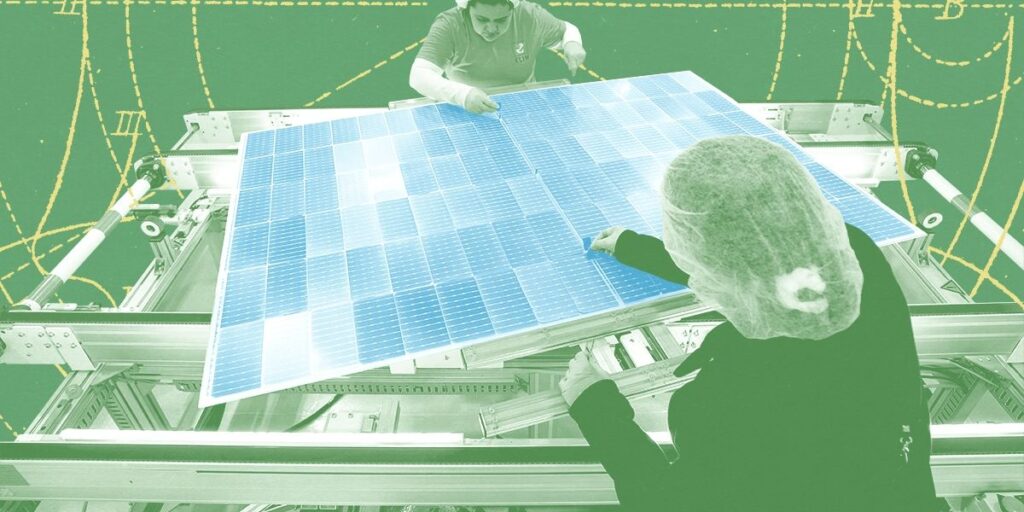
Two clean energy reports out this week offer seemingly contradictory snapshots of domestic solar and battery manufacturing. One, released Wednesday by the Rhodium Group’s Clean Investment Monitor, shows a distinct decline in investment going into U.S. factories to make more of these technologies. The other, released today by the trade group American Clean Power Association, shows staggering recent growth in production capacity.
So which is it? Is U.S. clean energy manufacturing booming or busting?
Maybe both.
The U.S. is suddenly producing more solar and batteries than ever before — enough to meet current domestic demand — so it makes sense that investment in new factories is starting to slow. At the same time, there’s a lot of room for growth in producing the upstream components that go into these technologies, but the U.S. is no longer as attractive a place to set up shop as it was over the past four years.
The U.S. saw 30 new utility-scale solar factories and 30 new battery factories come online last year alone, according to ACP. The country now has the capacity to meet average domestic demand for storage systems through 2030, and can produce enough solar panels to satisfy demand two times over.
In both industries, nearly all of that capacity has been added since 2022, when the Inflation Reduction Act created new subsidies for domestic manufacturing. The advanced manufacturing production tax credit incentivized not just solar and battery factories, but also all the production of components that go into these technologies, including solar and battery cells, polysilicon, wafers, and anodes. On top of these direct subsidies, the IRA generated demand for U.S.-made products by granting bonus tax credits for utility-scale solar and battery projects built with domestically produced parts.
“The policy definitely laid the right foundation for a lot of this investment to take place,” John Hensley, ACP’s senior vice president of markets and policy analysis, told me.
Trump’s One Big Beautiful Bill Act has changed the environment, however. The utility-scale wind and solar tax credits were supposed to apply through at least 2033, but now projects have to start construction by July 4, 2026 — just over a month from now — in order to claim them. Any of those projects that got started this year will also have to adhere to complex new sourcing rules prohibiting Chinese-made materials.
Now, dollars flowing into new U.S. solar factories appears to be on the decline. Investment fell 22% between the fourth quarter of last year and the first of 2026. Battery manufacturing investment dropped by 16%.
The reason investment is declining is not entirely because of OBBBA — it’s partly a function of the fact that a lot of the projects announced immediately after the IRA passed are entering operations, Hannah Hess, director of climate and energy at the Rhodium Group, told me.
Rhodium’s Clean Investment Monitor tracks two metrics, announcements and investment. Announcements are when a company says it’s building a new factory or expanding an existing one, usually with some kind of projected cost. Investments are an estimate of the actual dollars spent during a given quarter on facility construction, calculated based on the total project budget and the expected amount of time it will take to complete after breaking ground.
According to Rhodium’s data, the peak period for new solar manufacturing project announcements was the second half of 2022 through the first quarter of 2025. During that time, announcements averaged more than $2 billion per quarter. New solar factories announced this past quarter, by contrast, fell to about $350 million.
Since it can take a while to get steel in the ground, the peak period for investment was slightly later, with $13.5 billion invested between the second quarter of 2023 and the third quarter of 2025.
“What we were seeing in that post-IRA period was huge, almost unconstrained growth in that sector, and that’s not happening anymore,” Hess said.
Most of this growth occurred all the way downstream, at the final product assembly level — i.e. factories making solar and battery modules that still had to import many of the components that went into them. This was the “lowest hanging fruit” to bring to the U.S., Hensley, of ACP, told me, as the final assembly is the least technologically challenging part of the supply chain.
“These supply chains have momentum as they get going,” he said, “so as you establish those far downstream component manufacturing, you start to recruit all of the upstream manufacturing.” In other words, a solar cell manufacturer is far more likely to build in the U.S. if there’s a robust local market of module factories to buy the cells.
There’s evidence that’s still happening in spite of changes to the tax credit structure. The ACP report says that three solar cell factories came online between 2024 and today — one per year. If all of the additional factories that have been announced are built by 2030, the U.S. will have nearly enough capacity to meet all of its own demand for solar with domestic cells. Battery cell capacity is growing even faster, with three factories as of the end of 2025 and seven more expected to be complete by the end of this year, which will produce more than enough units to meet average annual demand.
It’s the next step up on the supply chain that spells trouble. For solar, that’s ingots and wafers, followed by polysilicon. Today, the only producer of ingots and wafers in the U.S. is a company called Corning. It produces enough to meet about 25% of current domestic solar cell production, but cell production will more than quadruple by the end of this year compared to last year, according to ACP. Similarly, we produce enough polysilicon to meet Corning’s current needs, but not enough to meet anticipated cell demand. The announced projects in the pipeline will not add much on either front.
For batteries, it’s the anodes and cathodes. There’s currently one factory in California producing cathodes and at least one more under construction, but as there is nothing else in the pipeline, the ACP report expects cell manufacturers to rely on imported cathodes for the foreseeable future. Anodes are the one bright spot — there’s one factory producing what’s known as active anode material factory in the U.S., and four more anticipated by the end of this year. Together, they have the potential to meet demand by 2028, according to ACP.
The question now is whether that snowball effect kicked off by the IRA will continue. “A lot has changed about the outlook for future demand after the One Big Beautiful Bill Act passed,” Hess said. “We have seen some more project cancellations and pauses in construction recently.”
Most recently, a company called Maxeon Solar Technologies canceled a $1 billion cell and module factory in New Mexico. The company had been “fighting for its life” since 2024, according to Canary Media. It’s also majority owned by a Chinese state-owned company. The
OBBBA was likely the nail in the coffin, as it penalizes solar developers who source panels from companies with Chinese ownership.
OBBBA also shortened the timeline for the wind and solar tax credits, while the Trump administration’s hostility to wind and solar permitting has made it more difficult for projects to get built before the credits expire. Hensley said the Trump administration’s hostility toward clean energy has added a lot of risk into the system, complicating final investment decisions for manufacturers.
On the flip side, tariffs have the potential to help some domestic producers. Duties on imports from countries such as Cambodia, India, and Vietnam, all major manufacturers of solar panels, “have made their exports to the U.S. almost prohibitive,” Lara Hayim, the head of solar research at BloombergNEF, told me in an email. “This sort of policy framework could continue to provide some protection for domestic manufacturers,” she said, but there are still plenty of countries with low enough tariffs that they will continue to serve the U.S. and compete with domestic manufacturers.
Hensley said that the Trump administration’s tariffs were a double edged sword. They can help domestic manufacturers, but not if they make all of the inputs into the product more expensive.
“That’s a problem with these blanket type of tariffs that aren’t really fine-tuned to target the behavior that you’d like to see,” he told me. “I think we’re seeing a lot of that push and pull and tension in the system at the moment.”
Between Trump’s tariffs and the OBBBA, there’s no doubt that the manufacturing boom sparked by the IRA is slowing. But Hensley is optimistic that the progress will continue. “We haven’t attracted all of the supply chain yet. It’s still a work in progress, but so far the signs are quite good.”