Hydrogen Fuel Cells vs Batteries: Which One Actually Wins for Electric Heavy Industry?
Every conversation about clean energy eventually lands a particular question. Hydrogen fuel cells or batteries? The challenge is that industrial energy systems are rarely defined by a single variable. Productivity, uptime, infrastructure, operating environment, and scale all influence the answer.
Electric vehicles have received significant attention over the past decade. Falling battery costs, expanded charging infrastructure, and broader adoption have made battery electric passenger vehicles a central part of the energy transition.
Heavy industrial environments operate under different constraints. Warehouses, distribution centers, heavy-duty trucking fleets, and backup power systems prioritize continuous operation, productivity, refueling speed, and facility efficiency. In these applications, the technology that performs well for passenger transportation does not always align with industrial operating requirements.
This comparison examines where battery electric systems perform effectively, where operational limitations emerge, and where hydrogen fuel cells continue to demonstrate advantages in demanding industrial applications.
What We Mean by Heavy Industry
Heavy industry, for the purposes of this comparison, covers three main areas.
The first is material handling. This includes forklifts, pallet jacks, and lift trucks operating in warehouses, distribution centers, and cold storage facilities. These vehicles run in multi-shift operations, often 24 hours a day, in environments where downtime directly affects productivity.
The second is heavy-duty trucking. Class 8 trucks, long-haul freight carriers, and port vehicles moving large loads across significant distances operate under very different requirements from passenger vehicles.
The third is commercial maritime. Cargo vessels, ferries, and port operations require energy solutions that support long operating cycles, significant power demands, and limited refueling opportunities. As the maritime sector pursues lower-emission operations, both battery electric and hydrogen technologies are being evaluated for different vessel types and use cases.
Each of these applications places different demands on refueling time, operating conditions, infrastructure, payload capacity, and uptime.
Where EVs Perform Well
Battery electric vehicles, or BEVs, perform well in several applications.
For short-haul and predictable routes, BEVs can provide strong operating economics. Urban delivery fleets operating on fixed schedules can build charging infrastructure around established routes, allowing lower energy costs per mile to become an advantage over time.
Battery technology has also improved significantly. Many commercial BEVs now achieve 200 to 400 miles of range per charge, while charging infrastructure continues to expand across North America and Europe. Production scale has also contributed to lower upfront costs.
For passenger transportation and light commercial applications, battery electric systems continue to gain adoption. These use cases generally operate with planned charging windows, lower payload requirements, and less demanding utilization schedules.
Where the EV Case Gets More Complex in Heavy Industry
In heavy industrial applications, battery systems encounter several operational constraints.
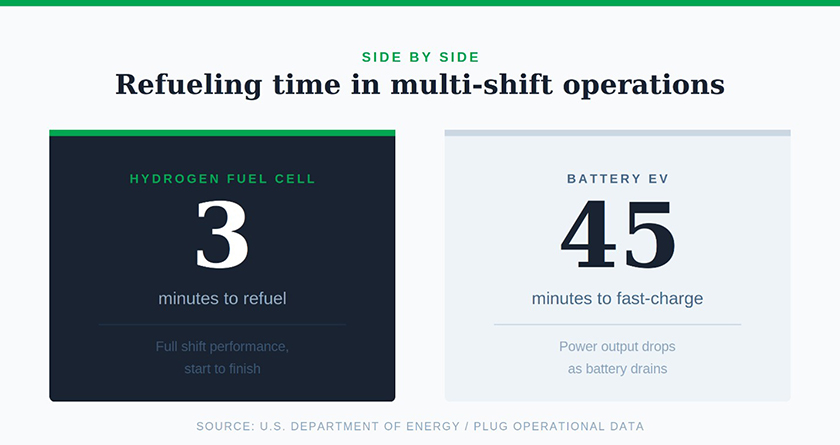
Charging time remains a major operational consideration. Standard commercial battery systems can require several hours to recharge. Even fast-charging systems may require 30 to 45 minutes depending on the vehicle and battery size. In high-throughput warehouse environments operating across multiple shifts, that downtime directly affects productivity and equipment utilization.
Battery performance can decline in cold environments. Cold storage facilities operate at temperatures that reduce battery efficiency and available range. Lithium-ion batteries can lose a meaningful portion of usable capacity in freezer-level environments, creating operational challenges for facilities handling frozen food and pharmaceutical products.
Infrastructure requirements are often larger than expected. Installing charging systems for large industrial fleets frequently requires utility upgrades, dedicated charging rooms, and expanded electrical capacity. For new facilities, these requirements can increase both project complexity and upfront infrastructure costs.
Weight and range limitations affect heavy-duty trucking. Long-haul Class 8 trucks require larger battery packs to maintain range across extended routes. Additional battery weight reduces payload capacity, creating a tradeoff between range, cargo weight, and vehicle efficiency.
Where Hydrogen Fuel Cells Change the Equation
Hydrogen fuel cells operate differently from batteries. Instead of storing electricity, fuel cells generate electricity through a chemical reaction between hydrogen and oxygen. The reaction produces electricity, heat, and water vapor at the point of use.
This operating model creates different performance characteristics from battery-powered systems.
Refueling takes minutes rather than hours. A hydrogen fuel cell forklift can typically be refueled in less than three minutes. In multi-shift warehouse environments, this allows equipment to remain in operation throughout the day without extended charging downtime. Plug operational data also shows consistent performance throughout shifts without the voltage drop and reduced lift speeds associated with battery discharge.
Performance remains consistent throughout the shift. Battery-powered forklifts often experience reduced lift speed and lower power output as charge levels decline. Hydrogen fuel cells maintain more consistent power delivery from the beginning of a shift through completion. In facilities where productivity is measured in picks per hour, consistency directly affects throughput.
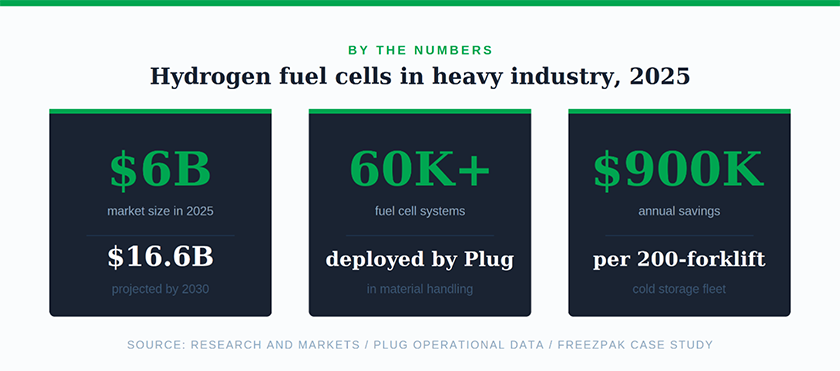
Cold temperature operations remain stable. Hydrogen fuel cells are less affected by freezer-level temperatures than lithium-ion battery systems. Plug fuel cell forklifts operate in environments as cold as -22 degrees Fahrenheit. FreezPak reported annual savings of approximately $900,000 after converting a 200-forklift fleet to hydrogen, driven largely by reduced downtime and operational consistency.
Infrastructure footprint can be smaller. Hydrogen fueling stations are compact and can be positioned flexibly within a facility. Large battery charging rooms and extensive electrical upgrades are not always required. In high-density distribution centers, reclaiming operational floor space can create measurable business value.
Grid independence and operational resilience matters in some applications. Grid reliability is becoming a larger operational concern for industrial facilities. As warehouses and distribution centers add automation, refrigeration systems, and electrically powered equipment, power demand continues to increase. In many facilities, large battery charging operations can create significant peak electricity loads and require costly electrical infrastructure upgrades.
Hydrogen fuel cells generate electricity through an on-site chemical process and do not rely on continuous grid access during operation. By eliminating extended battery charging cycles while maintaining continuous operation throughout shifts, fuel cells can reduce pressure on facility power infrastructure and improve operational flexibility. For facilities where uptime directly affects productivity, or where electrical capacity and grid reliability are constrained, this operational resilience can become a meaningful business advantage.
The Heavy-Duty Trucking Picture
The comparison becomes more nuanced in long-haul trucking applications.
Battery electric trucks continue to make progress in short and medium-haul routes. Vehicles such as Tesla’s Semi demonstrate that battery electric systems can support defined routes with planned charging infrastructure.
For long-distance freight movement without fixed routes, range and payload limitations remain more challenging. Hydrogen fuel cell trucks provide refueling characteristics and operating range that more closely resemble diesel systems while reducing emissions.
In Switzerland, 48 Hyundai XCIENT fuel cell trucks completed 10 million kilometers of transport activity by June 2024 using green hydrogen, reducing approximately 6,300 tonnes of carbon dioxide compared with diesel alternatives. Volvo Trucks also began on-road testing of hydrogen-powered heavy trucks in early 2026, with commercial launch plans targeted before 2030.
Toyota introduced its third-generation fuel cell system in North America in 2025, delivering 20 percent greater efficiency than the prior generation and a projected service life of 600,000 miles for trucking applications.
These results come from active commercial deployments rather than controlled demonstration environments.
The Cost Question
Cost remains one of the most important parts of the comparison.
For passenger vehicles and light-duty commercial fleets, battery electric systems often provide a lower total cost of ownership. Charging infrastructure is increasingly available, electricity costs can be favorable, and battery manufacturing scale continues to improve economics.
For heavy industrial applications, the calculation changes. U.S. Department of Energy (DOE) comparisons between fuel cell forklifts and battery-powered systems found comparable annual ownership costs, with hydrogen systems demonstrating advantages in high-utilization, multi-shift environments. Eliminating large battery charging rooms can also create additional operational value that does not appear directly in fuel cost comparisons.
Hydrogen fuel costs remain higher than grid electricity on a per-unit basis. Producers continue working to reduce those costs through larger-scale production, improved electrolysis systems, and renewable energy integration. As production volumes increase and electrolyzer technology advances, the economics of green hydrogen continue to improve. According to the DOE, the hydrogen fuel cell market was valued at approximately $6 billion in 2025 and is projected to reach $16.6 billion by 2030.
So Which One Actually Wins?
Neither is technology the best fit for every application.
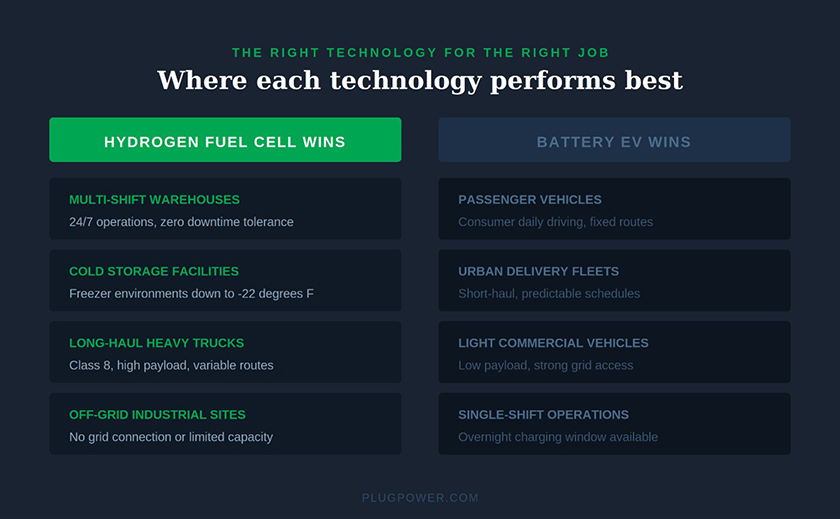
Battery electric systems are often well suited for passenger transportation, light-duty urban fleets, and commercial routes with predictable schedules and available charging infrastructure.
Hydrogen fuel cells continue to demonstrate advantages in multi-shift warehouse operations, cold storage environments, high-throughput distribution centers, heavy-duty transport applications, and facilities where refueling speed or grid flexibility are operational priorities.
The most effective industrial energy strategies are typically built around operational fit rather than a single universal solution. Companies focused on uptime, productivity, and efficiency evaluate technologies according to the requirements of the specific application.
In several demanding industrial environments, hydrogen fuel cells continue to demonstrate operational advantages that battery systems struggle to match consistently. Current deployment data from commercial fleets continues to support that trend.
What This Means for Operations Leaders
For warehouse operators, distribution centers, and industrial facilities, the most important question is not which technology receives more public attention. The more important question is which system aligns with the operating conditions inside the facility.
Evaluate how many shifts the fleet operates each day. Evaluate cold storage requirements, available floor space, forklift downtime costs, and existing electrical capacity. These operational factors often determine whether battery electric systems or hydrogen fuel cells create a better long-term fit.
Plug has deployed more than 60,000 fuel cell systems across material handling operations worldwide. The operational data from those deployments reflects real-world industrial environments and long-term customer use cases. For organizations evaluating industrial energy strategies, deployment performance in comparable operations remains one of the most valuable benchmarks available.