Liddell Power Station demolition underway after 50 years of operation
More than half a century of coal-fired history has come crashing down in the NSW Hunter Valley.
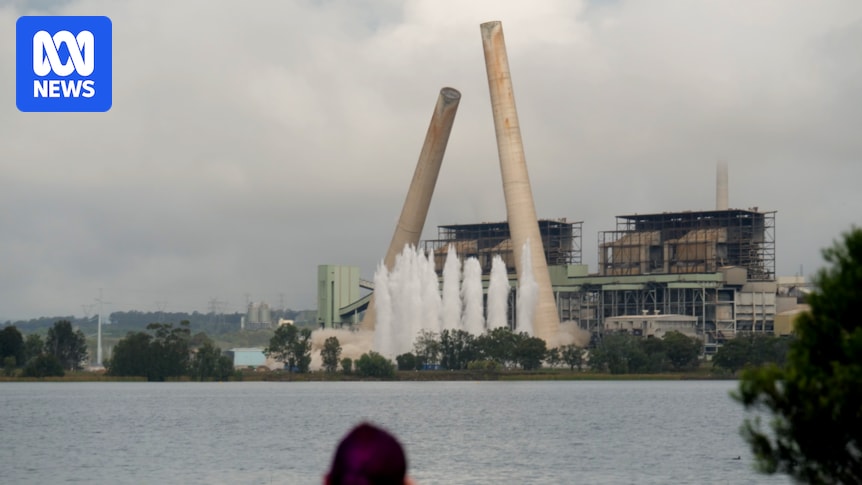
The Liddell Power Station’s iconic 170-metre-tall chimneys were demolished with explosives packed into their base.
The power station was retired in 2023 after 52 years of operation.
The moment the chimneys at the Liddell power station were demolished. (ABC Newcastle: Amelia Bernasconi)
Steve Lanesbury worked at the station for 44 years.
“The emotions are pretty raw. It’s like someone with a terminal illness,” he said.
“We put her on life support back in 2023 … and the stacks coming down, that’s the signal that this is the end.”
The power station shortly before its chimneys were demolished. (ABC Newcastle: Ross McLaughlin)
AGL site transition general manager Brad Williams said it was “a bittersweet moment”.
“These stacks have been an icon for the site, the region, and the community for a number of decades, and particularly for our former employees,” he said.
“Bringing these stacks down really does signify a move into opening the site for reuse as an industrial energy hub, and with that comes new jobs, new opportunities and new developments.”
‘Like bringing down a tree’
Since its closure, the demolition of Liddell’s chimneys has been the subject of community interest, but safety concerns meant there was no public viewing.
Each smoke stack had a base diameter of 20m and narrowed to 10m at the top.
“It’s like bringing down a tree … rather than using an axe, we use explosives,” Mr Williams said.
“About 700 holes are drilled in the side of the chimney and they’re packed with a small amount of explosives.
“Then we cut … triangular sections that act as a hinge and then cut through the reinforcement at the base and rear of the stack.
“It’s an awful lot of work for a 10-second event to safely bring them down.“
The chimneys have a diameter of 20 metres at the base. (ABC Upper Hunter: Bindi Bryce)
Over the past 18 months, the site has been cleaned out and disconnected.
“As much as what we possibly could has been recycled throughout that process, for example, about a million litres of oil has been recycled,” Mr Williams said.
‘We’re going to see more of this’
The Liddell Power Station was the largest power station of its kind when it was fully operational in 1973.
The cost of maintaining ageing infrastructure and AGL’s shifting focus to cleaner energy led to its 2023 closure.
It was among the 1 per cent of power stations in the world to have operated for more than 50 years.
During its lifetime, Liddell generated about 431,000 gigawatt hours of power. At consumption rates at the time of its closure, that was enough to power NSW for 6.5 years.
The neighbouring Bayswater Power Station, also owned by AGL, is due to close in 2033.
Liddell, pictured here in 1972, was one Australia’s longest running coal-fired power stations. (ABC Archive)
There were mixed emotions when Liddell powered down — most locals having some kind of connection to the site.
Margaret and David Channon met while working at Liddell and later married. Their son Jackson went on to work at the site.
Newcastle Institute for Energy and Resources director Paul Ebert said it was a significant moment in the state’s energy transition.
“This is really the first large-scale thermal power station that has got to the demolition phase. We’re going to see more of this,” he said.
“While there is a kind of grief in change … this particular asset has come to the end of its lifetime.”
Liddell Power Station during operation. (Supplied: AGL)
‘Fantastic potential’
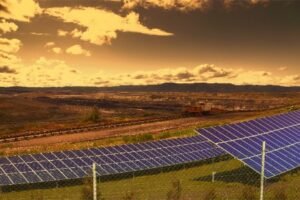
Mr Williams confirmed that a range of proposals were on the table for AGL’s Hunter Energy Hub, including solar panel manufacturing and recycling and a data hub.
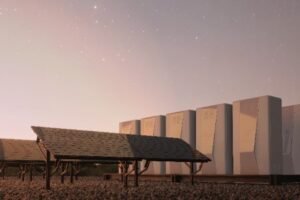
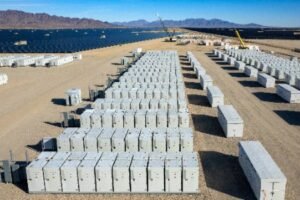
“We’ve made excellent progress on a large 500-megawatt, 2-hour battery on site, which is being commissioned at the moment, and the demolition really does open up future opportunities,” he said.
“The site has such fantastic potential: road access, water access, and industrial land ready for redevelopment.”
The 500-megawatt Liddell Battery was switched on for commissioning in March. (ABC Upper Hunter: Courtney Yeandle)
Prime Minister Anthony Albanese visited the Liddell site in 2024 to announce a $1 billion program aimed at boosting the number of solar panels made in Australia.
“We’re in discussions with a number of proponents at the moment with a range of different industries and ideas,” Mr Williams said.
“So there will be further announcements in due course.”