Opinion | From COP30 To 2030: India’s Path To Reliable Clean Power With FDRE | Opinion News
Last Updated:
The challenge ahead is no longer about building more solar plants or wind farms: it’s about ensuring that clean energy is available whenever people need it

Solar and wind energy, while clean and increasingly affordable, are weather-dependent and therefore variable.
The 30th Conference of Parties (COP30) delivered a clear message: the future of clean power depends not just on building more solar and wind capacity but on creating integrated renewable systems that can deliver electricity reliably at all hours. This change was signalled by major announcements in Belém, including a global Grids and Storage Package and a commitment from the Utilities for Net Zero Alliance to invest $148 billion annually, to ensure that renewable power can be transmitted, balanced, and dispatched when needed.
These pledges mark a growing recognition that renewable generation, storage, and grid infrastructure must advance together. This approach aligns closely with the principles of Firm and Dispatchable Renewable Energy (FDRE), which offers a pathway to make clean energy not only greener but also dependable.
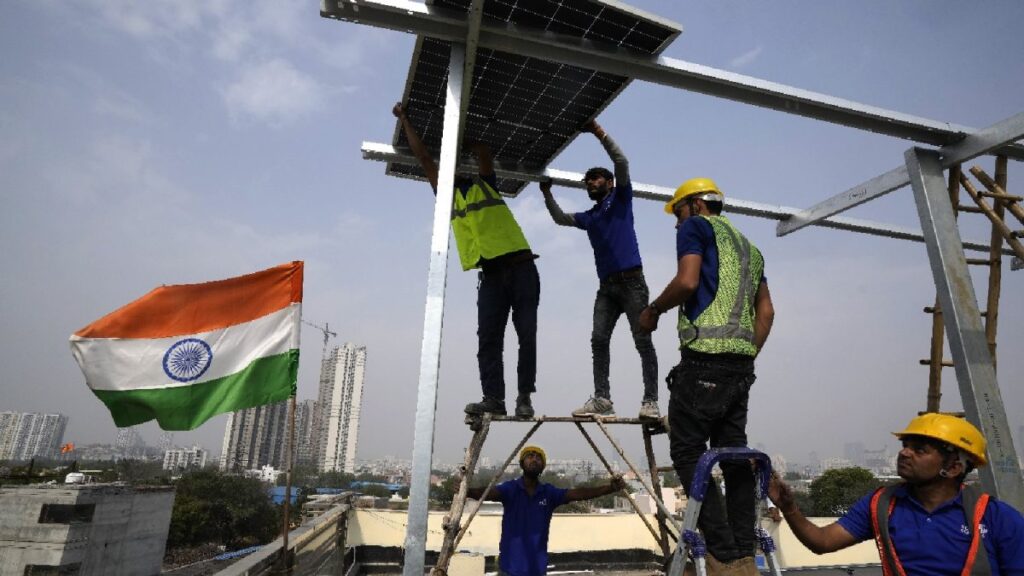
This renewed commitment towards reliable, clean power is especially relevant for India. The country now sources over half of its installed power capacity from non-fossil fuel sources and is advancing towards its 500-gigawatt non-fossil capacity target by 2030. However, the challenge ahead is no longer about building more solar plants or wind farms: it’s about ensuring that clean energy is available whenever people need it.
What Is FDRE?
Solar and wind energy, while clean and increasingly affordable, are weather-dependent and therefore variable. This is where FDRE becomes crucial, providing reliable renewable power at all times. By combining solar and wind power with energy storage solutions, such as batteries or pumped hydro, India can build clean power plants that provide steady, on-demand electricity without relying on fossil fuels.
Recognising this need, the Government of India launched a new tender format for FDRE projects in 2023. Under this new structure, these hybrid plants are expected to be designed to deliver electricity that matches demand patterns from distribution companies. Notably, the winning bids offered tariffs between Rs 4.50 and Rs 5.50 per unit, making them comparable to new coal generation costs.
However, unlike coal plants, FDRE projects offer much faster deployment timelines, eliminate the need for fuel imports, and result in substantially lower pollution. Also, research indicates that coal-based power generation has significant environmental and public health-related externalities, which substantially increase its true cost beyond the declared tariff. These factors underscore the importance of FDRE as one of the effective enablers for grid integration of renewables in India.
What’s Holding Back FDRE Adoption?
Despite its promise, the uptake of FDRE has been slower than expected.
First, developers face uncertainty in deciding the right mix of solar, wind, and storage needed to meet stringent reliability requirements specified in the tenders. The tender designs leave limited room for experimentation, even though India’s weather patterns vary widely by region.
Second, India’s electricity markets are still shallow. With limited trading volumes and constant price uncertainties in the electricity market, developers struggle to sell surplus power generated during favourable weather conditions, such as high wind speeds or abundant sunshine. Without streamlined revenue guarantees from selling excess power, many hesitate to size their projects optimally.
Third, electricity distributors tend to compare FDRE costs with standalone solar or wind prices, rather than with other firm power sources, such as coal or gas. This skews procurement decisions and makes FDRE appear costlier than it actually is.
The result: developers are cautious, buyers are uncertain, and a high-potential solution remains under-deployed.
What Can India Do Next?
To overcome these challenges and accelerate adoption, India needs targeted policy and financial support. Technology-neutral auctions can allow FDRE to compete directly with coal and gas for firm power contracts. Access to carbon markets can provide additional revenue for FDRE projects. By earning credits for avoided emissions and selling them to high-emission sectors, FDRE projects can be financially rewarded. Greater awareness among financiers and distribution companies will also help align expectations and improve confidence in these projects. COP30 has successfully brought the challenges of grid flexibility in a renewable-rich electricity system to the centre stage. Discussions at COP made clear that electricity sector decarbonisation can only be achieved by incorporating storage into the power mix. From this perspective, FDRE can be an essential bridge for India.
FDRE is not a substitute for other solutions; it is part of a broader toolkit that includes standalone renewables, storage, and smarter grid management. For India, it offers the assurance of powering growth with home-grown, reliable, and affordable clean energy. As the world advances towards a clean energy future, India’s experience with FDRE can demonstrate how ambition becomes implementation: how the lights can stay on, sustainably, every hour of the day.
Anasuya Gangopadhyay is a Senior Associate in the Climate Change Mitigation team at the Center for Study of Science, Technology and Policy (CSTEP), while Sunil Mani is a Policy Advisor at the International Institute for Sustainable Development (IISD). Views expressed in the above piece are personal and solely those of the writer. They do not necessarily reflect News18’s views.
November 27, 2025, 15:56 IST
Read More