Think the Liberals are struggling with clean energy? Meet me.
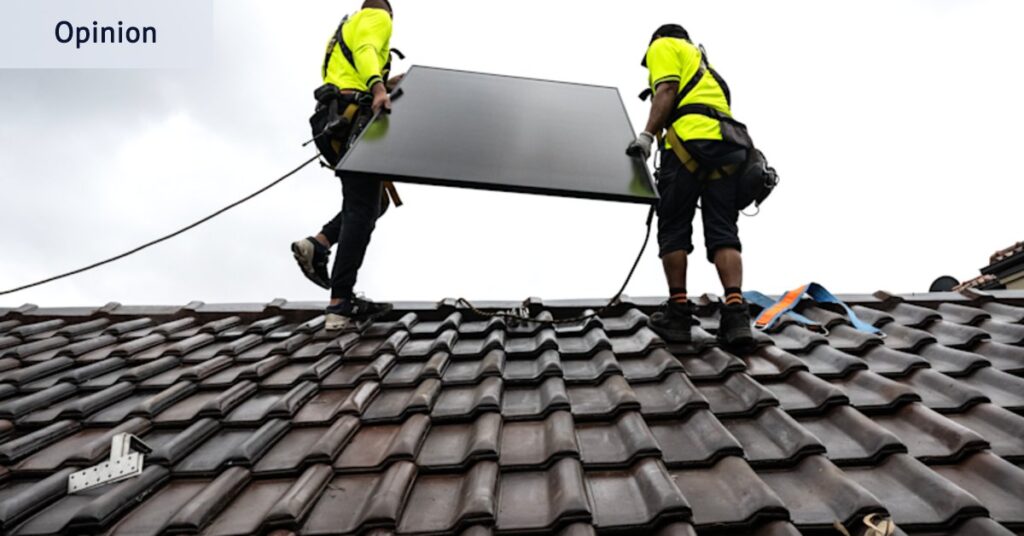
When you want an efficient electric home, you may require new switchboards, new fuses, new meters. And for some of us, new poles. Why? New wires for the house need to be high enough to clear passing traffic. Also, they definitely can’t cross over the neighbour’s property. Do not covet, oops cover, your neighbour’s property.
“We at Ausgrid provide network connection, the pole,” says Baxter. “Everything beyond that is the customer’s installation.”
Loading
And sure, there are about half a million Ausgrid poles in NSW while, in Victoria, there are more than 800,000 poles among the largest bloc of electricity distributors (Citipower, Powercor and United Energy). In comparison, there are only thousands of private poles, which cost each consumer thousands of dollars. The cost of those power-distributor poles is socialised. Those other poles? They’ll remain the consumer’s cost and responsibility. For eternity.
Anything to do with electricity is always going to cost you a bomb – and you will have to wait. It begins with sparkies, of whom there will never be enough and, for heaven’s sake, please ask your children to enrol at TAFE and become electricians for the good of the nation. Then it proceeds along poles, wires, meters, fuse boxes, that heat pump you can’t buy because yada, yada, yada, airflow, space-time continuum.
And phases. Much like the phases of the moon but three-phase power is required in this instance because of induction cooktops, reverse-cycle air-conditioning, instant hot water and the possibility of an electric vehicle down the track. Three separate level-two electricians (that’s an advanced accreditation) have recommended three-phase. (I add this because you have no idea of the number of non-certified punters who tell me we don’t need it. Everyone’s a freaking electrician now.)
Think this is too much information? Shakes head at your naivety. Also check out tree shadows. Roof structure. Aaiieeeeee.
Who did I turn to for help? Tim Forcey, author of My Efficient Electric Home Handbook, who also wrangles a hilarious Facebook page with thousands and thousands and thousands of posts. If I did a thematic analysis of those posts, confusion, concern and cost would be key themes. They are certainly mine. Forcey says he talks to people about comfort, energy, environmental performance. Is it the best use of your money? In our case, it’s not just about the money. His top tip: ask everyone you know about their experience. Talk to lots of people. Choose trusted, longtime retailers with reviews. Also, there is simple stuff you can do to make your home more comfortable, more energy-efficient.
And of course, I also talked to Gavin Gilchrist, an old journo. We go back decades but we lost touch. Now he’s the project manager for Inner West Community Energy, a registered charity and treasure. A total godsend. I sent IWEC all our quotes. In return, a recommendation from among the quotes. Gilchrist says that in both inner-suburban Sydney and Melbourne there has been relatively low uptake of solar.
“It wasn’t because people didn’t want solar,” he says. “It was because they didn’t know where to start.“
As Gilchrist points out (and I now know from personal experience), there are barriers for Australia’s older housing stock.
Loading
“People have the money and the willingness,” he says. The energy transition is the industrial revolution of the 21st century, after all.“But what help is there for people to navigate the transition?”
Rebates are all well and good but all the community energy groups across the nation are doing the planet’s work by helping translate solar into plain English and plain costing.
There’s a level of snark you have to deal with – the number of people who put their oar in and tell me solar will never pay for itself. And yet, bill to bill, it will cost less. (Yes, it will. We have 30 solar panels on the roof of our family home. The bill we used to have for two people before panels is far more than the bill we now have for six people and 20 loads of washing.)
We chose to do it because it’s better for the environment and better for my grandchildren in the long run. I mean, let’s face it, white bread ($2.29 at Aldi) is far cheaper than the fancy seeded spelt I love. It’s also not nearly as good for me.
Do it because it’s good for all of us. And then share your high-stress solar stories. Sign up to solar and take the Liberal Party with you.
Jenna Price is a regular columnist for The Sydney Morning Herald and The Age.