Why Solar Module Reliability Depends More on Encapsulation Films Than Ever Before
When discussing solar module performance, the industry often focuses on the most visible and measurable components:
- Higher-efficiency solar cells
- Advanced inverter technologies
- Premium glass solutions
- Optimized module designs
These technologies are undoubtedly important. However, one critical component often receives far less attention despite directly influencing the lifetime and energy output of a solar module: PV encapsulation films.
Encapsulation film is the invisible protection layer that surrounds and safeguards solar cells throughout decades of outdoor exposure. It acts as a barrier against moisture, UV radiation, thermal stress, and electrical degradation.
As photovoltaic technology enters a new era of higher efficiency and more demanding applications, the role of encapsulation films has become increasingly strategic.
A fundamental industry challenge is emerging:
- Improving solar cell efficiency without improving encapsulation reliability may limit real-world energy yield.
A module that achieves higher efficiency in laboratory conditions but suffers from accelerated degradation in real-world environments may ultimately deliver lower lifetime returns.
The future of solar energy is not only about producing more power on day one—it is about maintaining power generation for decades.
The Hidden Role of Encapsulation Films in Solar Module Reliability
A solar module is a complex multi-layer system consisting of:
- Glass
- Encapsulation film
- Solar cells
- Backsheet or rear glass
- Aluminum frame
- Junction box
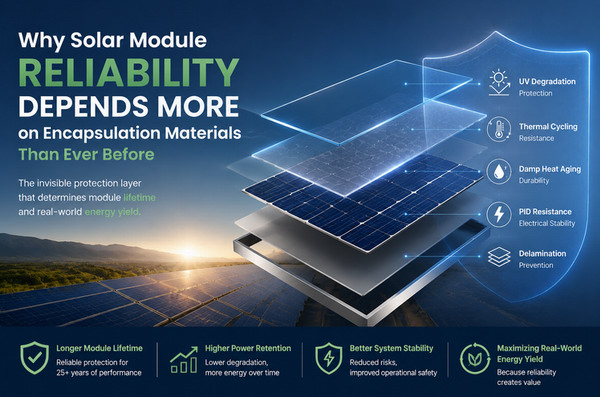
Among these components, encapsulation film performs several critical functions:
1. Mechanical Protection
Encapsulation films hold solar cells securely in place and absorb mechanical stress caused by:
- Transportation
- Installation
- Wind loads
- Thermal expansion and contraction
Without sufficient encapsulation strength, microcracks and cell damage can gradually reduce module performance.
2. Electrical Insulation
Modern solar modules operate at increasingly higher system voltages.
Encapsulation films help prevent:
- Leakage currents
- Ion migration
- Potential-induced degradation (PID)
Strong electrical insulation performance is essential for maintaining stable power output over long operating periods.
3. Environmental Protection
Solar modules are continuously exposed to harsh outdoor conditions:
- Intense sunlight
- Rain and humidity
- Temperature fluctuations
- Dust and pollutants
The encapsulation layer acts as the first line of defense, protecting sensitive solar cells from environmental damage.
Why Higher-Efficiency Solar Cells Create New Encapsulation Challenges
The rapid development of advanced PV technologies has significantly increased the requirements for encapsulation films.
TOPCon
TOPCon (Tunnel Oxide Passivated Contact) technology has become one of the fastest-growing next-generation solar cell technologies.
Its high efficiency relies on advanced passivation layers that improve carrier selectivity and reduce recombination losses.
However, these structures are sensitive to:
- UV exposure
- Moisture penetration
- Chemical degradation
Advanced encapsulation films help protect TOPCon cells by providing:
- Better UV resistance
- Lower moisture transmission
- Improved long-term stability
BC Modules
Back Contact (BC) technology removes front-side metal grids to maximize light absorption.
While this improves efficiency, it also introduces new reliability requirements.
BC modules require encapsulation solutions that can provide:
- Excellent adhesion
- Uniform stress distribution
- Strong resistance against thermal cycling
As cell structures become more sophisticated, encapsulation performance becomes increasingly important.
HJT
Heterojunction (HJT) technology combines crystalline silicon with thin-film layers to achieve high conversion efficiency.
However, HJT modules are more sensitive to:
- Temperature variations
- Moisture exposure
- Material compatibility issues
High-performance encapsulation films help maintain the stability of these delicate structures.
Perovskite Tandem
Perovskite tandem solar cells represent one of the most promising future PV technologies.
However, perovskite materials face significant challenges:
- Water vapor sensitivity
- Oxygen degradation
- Thermal instability
Future encapsulation solutions must achieve:
- Ultra-low moisture transmission
- High transparency
- Chemical compatibility
- Long-term barrier performance
The development of advanced encapsulation films will directly influence the commercialization speed of perovskite technologies.
Five Major Reliability Challenges Controlled by Encapsulation Films
1. UV Degradation
Solar modules operate under constant ultraviolet radiation for decades.
UV exposure can cause:
- Polymer aging
- Optical degradation
- Reduced transparency
- Material discoloration
These effects gradually reduce the amount of sunlight reaching solar cells.
Advanced encapsulation films incorporate:
- UV-resistant polymer structures
- Stabilization technologies
- Improved molecular durability
These features help maintain optical performance and prevent premature module aging.
This is especially important for harsh environments such as:
- Desert solar farms
- High-altitude PV projects
- Tropical regions
where UV intensity is significantly higher.
2. Thermal Cycling
Solar modules experience continuous temperature fluctuations.
A typical module may face:
- Cold nights
- Intense daytime heating
- Seasonal temperature changes
Repeated expansion and contraction can create stress between different materials.
Over time, this may lead to:
- Microcracks
- Adhesion loss
- Internal stress accumulation
High-quality encapsulation materials provide:
- Better elasticity
- Stronger bonding
- Improved stress absorption
helping modules survive thousands of thermal cycles.
3. Damp Heat Aging
Humidity is one of the biggest threats to solar module reliability.
Moisture infiltration can cause:
- Cell corrosion
- Metal electrode degradation
- Adhesion failure
- Reduced insulation performance
Traditional EVA films have played an important role in PV development, but advanced applications increasingly require materials with stronger moisture barriers.
Modern solutions such as POE and EPE films provide:
- Lower water vapor transmission rates
- Improved moisture resistance
- Better long-term stability
This is especially valuable for:
- Coastal PV projects
- Floating solar systems
- Tropical climates
4. PID Resistance
Potential-induced degradation (PID) is one of the major causes of power loss in photovoltaic systems.
PID occurs when:
- High voltage stress
- Moisture
- Ion migration
combine to affect cell performance.
Encapsulation films influence PID resistance through:
- Electrical insulation properties
- Moisture barrier performance
- Ion migration control
POE-based and advanced EPE encapsulation films have become increasingly important solutions for reducing PID risks in high-power modules.
5. Delamination
Delamination occurs when layers inside a solar module separate.
Common causes include:
- Poor adhesion
- Thermal stress
- Moisture exposure
- Material incompatibility
Delamination can result in:
- Reduced optical performance
- Moisture penetration
- Accelerated degradation
Reliable encapsulation films provide strong bonding between:
- Glass
- Solar cells
- Backsheets
maintaining module structural integrity throughout its lifetime.
The Evolution From EVA to Advanced Encapsulation Technologies
EVA
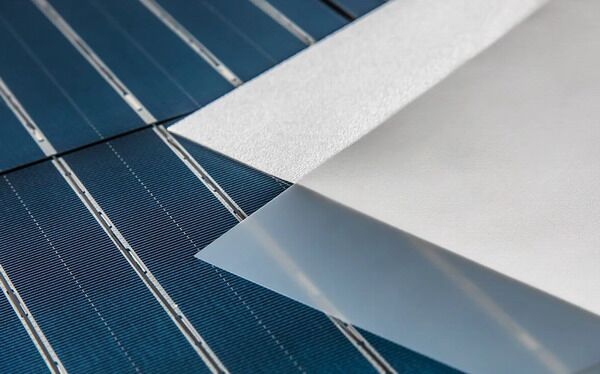
EVA solar film
EVA solar film remains one of the most widely used encapsulation films due to:
- Excellent transparency
- Strong adhesion
- Mature manufacturing processes
- Cost advantages
However, as module technologies advance, new reliability demands have emerged.
POE
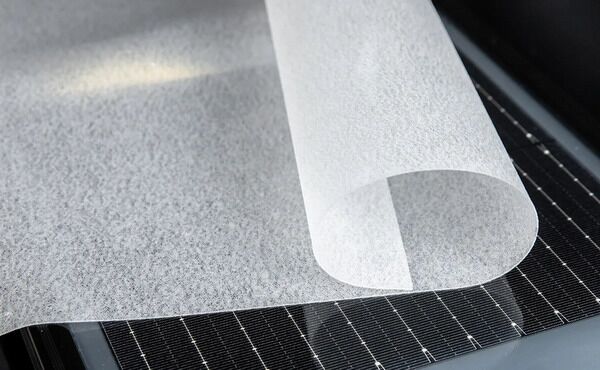
POE solar film
POE solar film offers:
- Superior moisture resistance
- Excellent PID resistance
- No acetic acid generation
It has become a preferred choice for:
- TOPCon modules
- HJT modules
- Bifacial modules
EPE
EPE solar film combines EVA and POE films’ advantages.
Benefits include:
TPO
Thermoplastic Polyolefin (TPO) represents a future-oriented approach.
Its advantages include:
- Chemical stability
- Low-temperature processing capability
- High barrier performance
making it suitable for emerging technologies such as perovskite tandem modules.
Encapsulation Films Will Define the Next Generation of Solar Reliability
The solar industry is entering a new stage where module efficiency alone cannot determine success.
The next generation of PV modules must achieve both:
Higher efficiency + Longer lifetime
Encapsulation films are the bridge connecting these two goals.
A highly efficient solar cell protected by an unreliable encapsulation system may lose its advantage after years of outdoor exposure. Conversely, advanced encapsulation technologies can help preserve performance, reduce degradation, and maximize lifetime energy generation.
The future competition in solar technology will not only happen at the cell level—it will also happen at the material level.