Jackery Explorer 1500 Ultra Power Station, Tested and Reviewed by Popular Mechanics
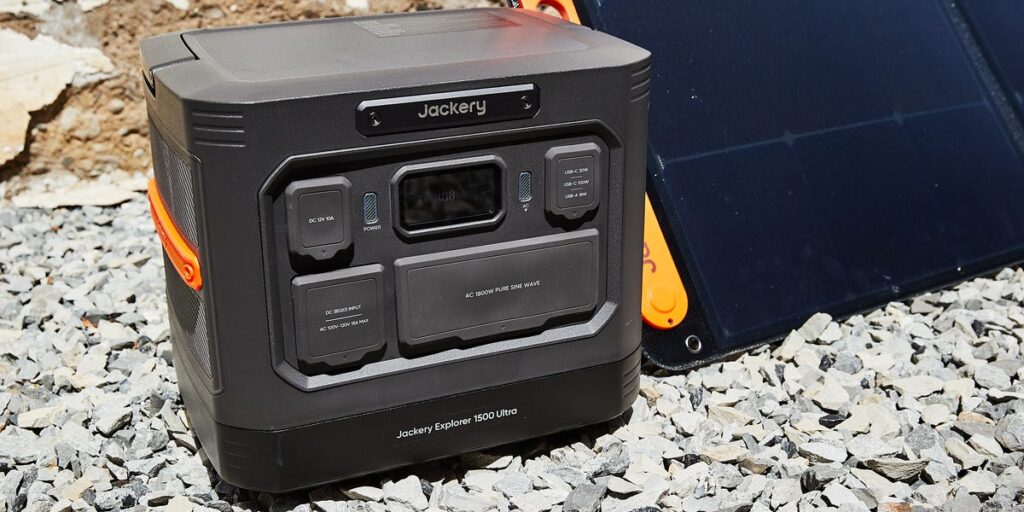
When I go camping, dust and mud are unavoidable. And no matter how hard I try to keep my gear clean, especially the sensitive electronic stuff, it’s a Sisyphean task.
This is especially a problem for a portable power station or solar generator, which can be damaged if you don’t keep it safe from the elements. That’s why some brands offer more “rugged” models that offer extra protection. Jackery’s Explorer 1500 Ultra power station is one of the latest, and I got a chance to put it to the test.
Indeed, the standout features of this 1,800-watt, 1,536-watt-hour-capacity power station center on increased durability, including rubber port covers, a cooling structure designed to avoid and redirect moisture, an IP65 weatherproof rating, a shockproof enclosure, and a bottom drainage design that can help keep water out of the enclosure should it get in there. Design is key for this power station, and in that, it covers all the bases.

Key Specs
| Power | 1,800 W (3,600 W surge) |
| Capacity | 1,536 Wh |
| Outputs | 3 x 120 V AC; 2 x USB-C; 1 x USB-A; 1 x 12 V DC |
| Weight | 38.6 Pounds |
Built for Bad Weather and Dusty Campsites
Sometimes the small things matter. My favorite elements of this power station are the rubber covers that fit over the ports and outlets. Not only do they seem to be constructed of a sturdy but flexible material, but the moldings are fitted to seal into place, essentially locking them in place when not in use. Some power stations use hard covers, which can be fine, but they aren’t sealed and can be potentially broken if you accidentally leave one open and hit something if you move the station around. That won’t happen here, and while this doesn’t seem like a big deal, I love it.
The overall construction of the 1500 Ultra is one of the strongest Jackery has made. It’s IPX65-rated for water and dust resistance, so you don’t have to worry too much if it gets rained on for a short time, or if you’re in a place like the desert, where dust is constantly blowing. One way it keeps water out is with a unique cooling system that places the fan, a titanium alloy plate, and vent holes at the bottom of the station.

Molded rubber seals keep the outlets protected from water and dust when not in use. I was impressed with how they fit snugly and locked into place.
The plate helps dissipate heat without multiple fans, and the placement of the entire system eliminates any side vents (typical in most power stations) that could allow droplets of water in. Meanwhile, an external plate on the bottom (pictured below) can be removed and dried if water does make its way in, something I’ve not seen a power station offer before.
The weight of using metal and heavier plastics, however, does make this station heavier than it looks. At 38.6 pounds, it has some heft for its size, but with a more vertical than horizontal shape and a large, sturdy handle, it’s pretty easy to move around. The extra heft also lends itself to the extra shock absorption this station features. Jackery claims that it’s reinforced to be “level 9 seismic shockproof,” but this is not an official third-party standard, such as an IPX rating.
Jackery also claims the 1500 Ultra is resistant to drops as high as one meter. I didn’t drop it from that height, but I was impressed with how strong the enclosure feels compared to other power stations I’ve reviewed in the past. If I were to drop it, I wouldn’t panic. My only complaint is that while there are protective rubber rails on both sides of the station, there isn’t one on the back, and I think it would make sense to have one there, too.

The 1500 Ultra has a unique cooling design that vents heat from below, rather than vents at the side, helping to keep moisture out. If it does make it in, you can remove a plate at the bottom to dry it out or remove any dust built-up.
Enough Power for a Weekend Away
The 1,800 watts of output power and 1,536 watt-hours of battery capacity are acceptable if you’re taking this camping for the weekend and need to recharge devices, run a low-powered small appliance or two, and plug in some lighting. This would not include something like a space heater, though. I tried to run one just to test out how it handled a high-wattage device, and the station shut down abruptly. It happily ran a two-slot toaster and a coffee machine, however.
There are some decent advanced settings that you can access through the mobile app, including a battery-saving mode that shuts off the alternating-current (AC) inverter if no load is detected. It also lets you set charging limits (this helps overall battery life) and limit AC recharging to the cheapest hours of the day if your local utility has fluctuating prices. But I was a bit disappointed to see that there weren’t more advanced settings with the app in relation to this power station, such as customizable input power (there are only fast and “eco” recharge settings). It’s not a deal breaker, but it’s something I see and really like in other brands’ apps.
Jackery also still insists on using the DC8020 input for solar panels instead of an Anderson input. Without an adapter, this locks you into using Jackery’s portable panels when connecting to a more standard MC4 solar connection found on most portable panels.
Who Is the 1500 Ultra Best Suited For?
If your camping trips or off-road adventures involve getting a little dirty, a power station like the Jackery Explorer 1500 Ultra is a solid choice. It delivers a medium amount of power, but maximum peace of mind that a little water, dust, mud, or an accidental drop won’t permanently damage your investment. It’s also very reasonably priced (usually on sale for well under $1,000), given that the competition charges more for outdoor and shock-resistant enhancements. Many power stations claim to be rugged, but this one makes good on its promise.
Other Editor-Recommended Power Stations
Most Compact

EcoFlow River 3 Power Station
Now 13% Off
Most Customizable

Bluetti Apex 300 Power Station
Best Value

Jackery Jackery Explorer 1000 v2 Power Station
Now 44% Off
David is a Reviews Editor for Hearst’s Enthusiast Group, contributing to Popular Mechanics, Runner’s World, Bicycling, Best Products, and Biography. He has over 25 years of experience writing about and reviewing consumer electronics, kitchen appliances, DIY products, outdoor gear, and more. He also spent years covering the ever-changing world of online retail. To relax, he loves experimenting with new recipes, tweaking his smart home setup, and spending time outdoors on his bike or camping.