How D.C. regulates clean energy and utility costs
At the Public Service Commission of the District of Columbia (Commission), we serve the public interest by ensuring residents receive safe, reliable, and affordable utility service while advancing the District’s clean energy goals. The push toward sustainability is transforming how we generate and consume power, which naturally prompts a very practical question from residents: How does clean energy impact my electricity bill?

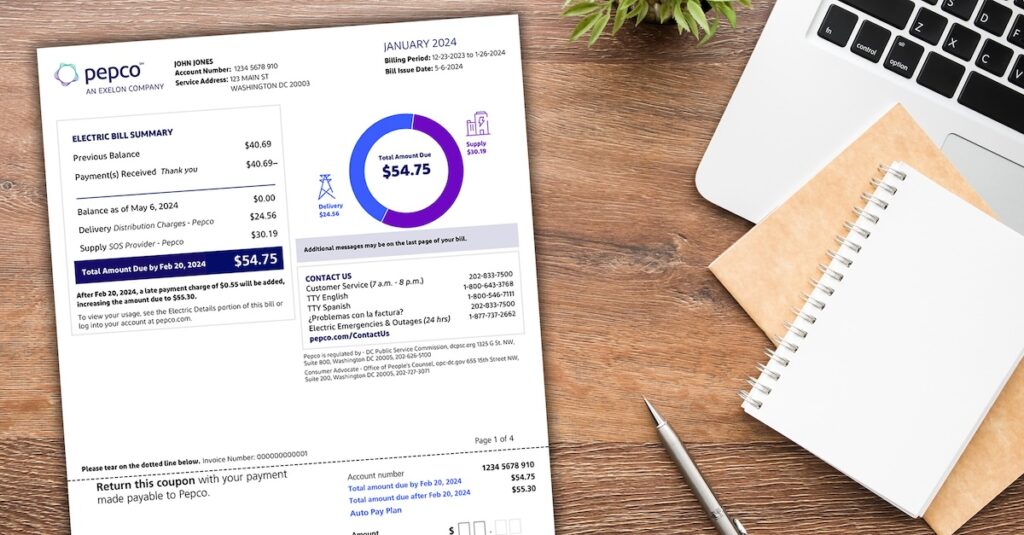
To answer that, it helps to understand exactly what makes up a monthly utility bill and where the Commission exercises its authority. A typical electric bill includes four main components: generation (supply), transmission, distribution, and taxes and surcharges.
Generation is the actual cost of producing electricity at a traditional power plant or from a renewable generator, like a solar panel. Transmission covers the massive high-voltage towers and lines that move power across our region. Distribution, which makes up about 27% of the average bill, is the local network of neighborhood poles, wires, and transformers delivering electricity directly to your home or business. Finally, taxes and surcharges reflect specific policy decisions and programs established through District legislation.
As the utility regulator, the Commission primarily oversees that 27% distribution portion. We operate much like a court, functioning as an independent, quasi-judicial body. When a utility proposes a rate change or a major infrastructure project, we do not simply rubber-stamp it. We rigorously review the proposal, weigh technical evidence, evaluate expert testimony, and gather crucial public input. Our mandate is to ensure every approved investment is justified, necessary, and ultimately benefits the public.

The remaining 73% of your bill falls largely outside our direct control, driven instead by regional wholesale energy market prices and legislative mandates. Understanding this distinction is essential when discussing the financial realities of clean energy.
Transitioning to a clean energy economy requires upfront investment. The traditional power grid was built for a one-way flow of electricity—from large, centralized power plants to consumers. Today, we are modernizing that system to handle a dynamic, two-way flow of energy, integrating localized renewable resources like rooftop solar and battery storage. Deploying these new technologies affects the distribution portion of your bill. However, these infrastructure upgrades are deliberately designed to reduce long-term costs.
Historically, electricity costs (particularly generation) have been linked to fluctuating fossil fuel prices. Coal and natural gas are subject to severe price swings driven by supply chain disruptions, extreme weather events, and global geopolitical conditions. Renewable energy fundamentally changes this dynamic. A solar panel or wind turbine has zero fuel cost. Once the infrastructure is built, these resources generate power with highly stable and predictable pricing over decades. Strategic investments in grid modernization today can shield consumers from the unpredictable price shocks of tomorrow.
To achieve this, the Commission insists on planning that is both forward-looking and heavily scrutinized for cost-effectiveness. Through our Electric Integrated Distribution System Planning (IDSP) process, we require utilities to ensure that grid investments are coordinated, highly efficient, and accurately matched to future energy demand. We cannot afford to build infrastructure blindly; it must be data-driven.
Additionally, our PowerPath DC Governance Board recommends pilot projects to test innovative energy solutions in real-world scenarios before scaling them up. We are actively exploring community heat pumps, solar aggregation, microgrids, and virtual power plants. By piloting these concepts first, we identify exactly which technologies deliver the highest return on investment and the most reliable service for District residents and businesses.
Expanding direct access to clean energy is another major priority. We have streamlined the solar interconnection process, leading to measurable local progress. In 2025 alone, the Commission certified more than 4,200 new solar facilities within the District. These installations allow residents and businesses to generate their own power, lower their individual bills, and ease the overall burden on the grid. For readers interested in tracking this transformation, we encourage you to review our annual Renewable Energy Portfolio Standard (RPS) Report at https://bit.ly/RPSreports to get details on the District’s steady progress toward achieving 100% renewable energy by 2032 and other climate goals.
Through all of these initiatives, protecting the ratepayer remains our primary goal. We continuously evaluate investments in existing, aging infrastructure to guarantee that safety and reliability are never compromised, while ensuring every dollar is spent wisely. We know that energy bills place a real strain on many household budgets, making transparency, public accountability, and careful regulation more critical than ever.
Building a sustainable grid requires navigating complex economic and technical realities. Our responsibility at the Commission is to manage this transition so that the energy system of the future is stable, accessible, and affordable for everyone in the District.